Abundance is a communal act… Community doesn’t just create abundance –
community IS abundance. If we could learn that equation from the world of nature, the human world might be transformed.
– Parker Palmer
This year, spring has been taking its time to return.
Although it still has not fully sprung,  I have been savouring some of the hallmarks of our seasonal transition – like the well-missed early morning stream of sunlight kissing me awake, bursts of cherry blossom trees adorning the streets, the harbour waters coming alive with kayakers. And, of course, smiling passersby, responding (like me) to all the evidence of abundance as we finally emerge from hibernation mode.
For me, winter is about coming home to myself in inward ways; this season is more about connecting outward, including renewing social relationships. As I exchange words or smiles with those who cross my path throughout the day or spend quality time with people near and dear to me, I notice how these genuine moments of human interaction in my daily life, too, have a graced and powerful way of bringing me more deeply home to myself.
The other day, a vivid image sprang to mind – the sacred circle – from a pocket book, once gifted to me by a friend, called Awakening Kindness, by Pema Chödron. And her wise words: “You are always standing in the middle of sacred space, standing in the middle of the circle…. Everyone who walks up to you has entered that sacred space, and it is not an accident. Whatever comes into the space is there to teach you” (p. 59).
 These words, as always, have the effect of opening my perspective to the reality of our interdependence, getting me more curious about the range of my daily interactions, and reminding me of the holiness of every encounter in all dimensions of my life, whether fleeting or more constant. From this vantage point, I can’t help but perceive others, and the web of all my experiences, in fact, through the lens of appreciation, acceptance and love.
We all have seasons when our social networks will ebb or flow, depending on our in-the-moment circumstances and life stages. There are times when solitude seems more fitting, or we need space to grieve losses or work through challenges in our various relationships. Some of us identify as extroverted; others, introverted.
But when it comes right down to it, we are by nature social animals; we are wired to 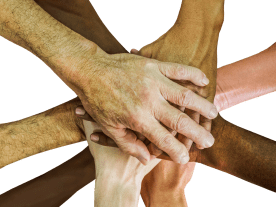 connect and have a fundamental need to experience a sense of belonging. As innumerable official sources tell us, our blessed supportive social networks – from friends, to family, to work colleagues, to wider community – are a key determinant of our health, longevity and well-being. They help us to navigate our life transitions. Spending quality time with nourishing empathic relations has the capacity to bring our emotion regulation systems into balance, releasing that feel-good hug hormone, oxytocin, shifting us into a more relaxed parasympathetic mode.
The return of spring: A celebration of our web of life and the felt sense of abundance that our relationships and communities offer us. We are here for one another, and have the awesome capacity to bring one another home to ourselves.
As you move through your day, notice who has joined you in your sacred circle. How are you experiencing your various interactions? Which feel connecting and nourishing, however you define this for yourself? How can you create more opportunities for such moments of relating?

Here is a version of an exercise I love to practise when I feel in need of a sense of care and connection. You may want to pull out of piece of paper and coloured pencils, or simply close your eyes and visualize:
Imagine yourself in the middle of your own sacred cir cle.
cle.
In your own time, call to you any person you know or have known (or perhaps, even, will know) with whom you have felt understood, accepted, respected, supported, or uplifted.
Feel these beings surround you, perhaps allowing a loving circle to form itself around you.
Feel free to invite in any other cherished supports as well, like beloved companion animals, places in nature (for me, the ocean is a great refuge), perhaps even the non-physical, or your ancestors. Sense the care and love radiating toward you; allow yourself to bask in this abundant field of love.
Know that you can regularly tap back into this field as a daily practice to connect to the felt sense of loving community. And like many other similar exercises, through the power of visualization and taking in the felt sense of this imagined experience, we are positively impacting the neuro-networks and well-being of our brains and whole selves. (See this short article by Rick Hanson for more info.)
And for those of you interested in connection and compassion in the workplace, I would recommend this great book, Awakening Compassion at Work: The Quiet Power that Elevates People and Organizations by Monica C. Worline and Jane E. Dutton.
 ents by others
 ething foundational about courage. As put by May, “The word courage comes from the same stem as the French word coeur, meaning “heart.” Thus just as one’s heart, by pumping blood to one’s arms, legs, and brain enables all the other physical organs to function, so courage makes possible all the psychological virtues. Without courage other values wither away into mere facsimiles of virtue.” (The Courage to Create, p. 13)
 courage to be authentic is what truly transforms our lives. And it is not an easy road, as it involves leaning into the discomfort of uncertainty – facing fearful experience(s), taking risks and being willing to expose ourselves. “We must dare to show up and let ourselves be seen.”
 sadness…) as they take their fleeting course through my system… then visualize a flow of self-directed love to all the cells of my precious being and to fear itself
 ING GOOD!” kept reverberating within – almost as a sweet reminder to keep growing this habit (or perhaps, rather, this way of being) unabashedly. Then, just the other day, at a NIA dance class, the instructor echoed this prompt when she proclaimed the words, “Source Pleasure!” And so, this blog is devoted to a very significant topic: the savouring and celebration of moments of sheer good-feeling, fun, delight!
 f human flourishing. They rocked my world, affirmed what I already knew, and encouraged me to continue to engage in practices that helped me to shift from a mental stance of expecting suffering to flourishing. And my practices – such as singing, ocean-walking with friends, gratitude – had me understand on a visceral level that creating experiences that bring joy and nourishment not only feel good, but they are truly an investment in my well-being and those around me.
 She goes on to explain how our brains are designed, since back in the caveman days, to focus on threat for survival’s sake. So nowadays, we still have a well-developed “negativity bias” which lead us to put our weighted attention on the “negative” in our lives. For example, at the end of the day, we might dwell on that one unpleasant conversation we had in the grocery store rather than the glorious day as a whole. Furthermore, positive emotions like joy, awe, and interest tend to be more subtle and fleeting than negative emotions. And so, we need to regularly create more positive-feeling moments to help us to counterbalance our tendency to focus on the more unpleasant elements in our daily lives and develop a deep reserve.
 While I am a staunch believer in the importance of being mindful and honouring of all of our experiences (the so-called good, the bad and the ugly), I also believe in prioritizing practices that enhance feelings of positivity and deepen connections to myself and all that is a part of the web of life.